
High Pressure Stopped-Flow System
Product Codes: HPSF-56
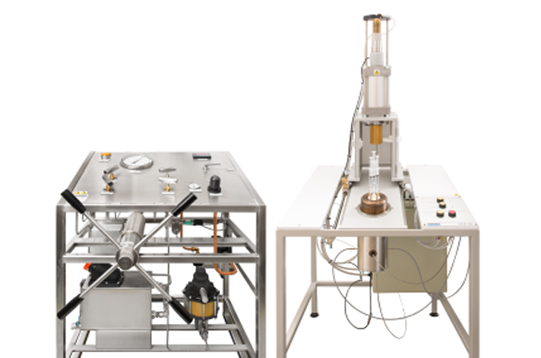
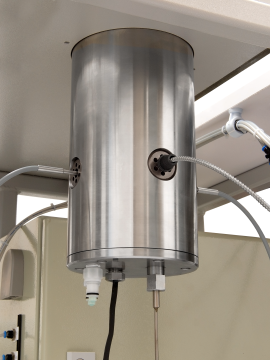
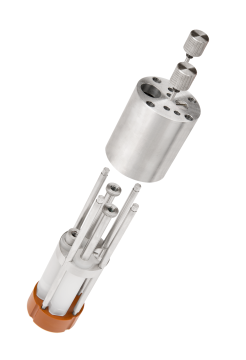
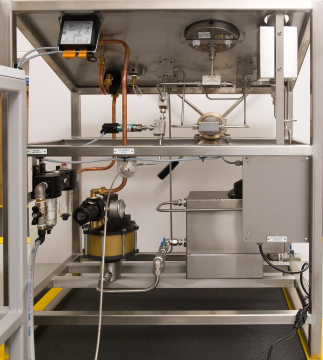
With both UV/Vis absorption and fluorescence measurement capabilities, the system has an empirical dead time of less than 10 ms and allows stopped-flow determinations to be made at pressures up to 2000 bar.
A proven design which given the demanding nature of this technique, is quite easy to use. The chemically inert flow circuit and observation cell has 3 sapphire observation windows which provide direct coupling between the sample cell and the optical fibres. The sample handling system is mounted in a frame that carries associated support equipment and can be loaded with sufficient reagent for 25-30 experiments. The pneumatic press is mounted on a track to allow it to be moved aside whilst loading the pressure vessel.
System pressure is generated by a pressure intensifier with a hand pump for small adjustments to ensure accuracy. Continuous and accurate monitoring of pressure is achieved using a transducer and digital display. Comprehensive safety interlocks protect both the system and operator.
The stainless steel (17-4PH) pressure vessel has an integral thermostated jacket and a temperature monitor provided.
An adjustable incremental sample drive system ensures rapid and effective mixing of solutions and data triggering. This system can be used with photomultiplier and photo diode array detection using Kinetic Studio.
Probing isotope effects in enzyme catalysis using High Pressure Stopped-Flow
In recent work*1 a HPSF-56 high pressure stopped-flow system equipped with a KinetaScan diode array system has been used at the Manchester Interdisciplinary Biocentre, UK by Professor Nigel Scrutton and co-workers to study the pressure dependence of kinetic isotope effects, coupled with a study of their temperature dependence, as a probe for promoting motions in enzymatic hydrogen-tunnelling reactions. Employing morphinone reductase as a model system they have measured the hydride transfer rate (a tunnelling reaction) as a function of hydrostatic pressure and temperature. Increasing the pressure from 1 bar to 2 kbar was found to accelerate the hydride transfer reaction when both protium and deuterium are transferred.
*1Hay,S., Sutcliffe,M.J. and Scrutton,N.S. (2007) Promoting motions in enzyme catalysis probed by pressure studies of kinetic isotope effects. PNAS, January 9, 104, no. 2, pp. 507-512.
Selected Publications
- Hay, S., Brenner, S., Khara, B., Quinn, A.M., Rigby, S.E.J. and Scrutton, N.S. (2010) Nature of the Energy Landscape for Gated Electron Transfer in a Dynamic Redox Protein. J. AM. CHEM. SOC.,132, pp. 9738-9745.
- Hay, S., Pudney, C.R., Sutcliffe, M.J. and Scrutton, N.S. (2010) Probing active site geometry using high pressure and secondary isotope effects in an enzyme-catalysed ‘deep’ H-tunnelling reaction. J. Phys. Org. Chem., July 1, 23(7), pp. 696-701.
- Hay,S., Evans, R.M., Levy, C., Loveridge, E.J., Wang, X., Leys, D., Alleman, R.K., and Scrutton, N. (2009) Are the Catalytic Properties of Enzymes from Piezophilic Organisms Pressure Adapted? ChemBioChem, September 21,10, issue 14, pp. 2348-2353.
- Pudney, C.R., McGrory, T., Lafite, P., Pang, J., Hay, S., Leys, D., Sutcliffe, M.J. and Scrutton, N.S. (2009) Parallel Pathways and Free-Energy Landscapes for Enzymatic Hydride Transfer Probed by Hydrostatic Pressure. ChemBioChem, May 25,10, issue 8, pp. 1379-1384.
- Hay, S., Pudney, C.R., McGrory, T., Pang, J., Sutcliffe, M.J. and Scrutton, N.S. (2009) Barrier Compression Enhances an Enzymatic Hydrogen-Transfer Reaction. Angewandte Chemie, February 9,121, issue 8, pp. 1480-1482.
Our Instruments
How can we help you?
Get in touch if you would like more information about any of our instruments or services.
T: +44 (0)1225 868699E: hi-tech@tgkscientific.com Get in touch